Boosting your Tests with Elasticsearch using TestContainers-Go

Thursday, Sep 30, 2021

TestContainers is a popular framework that allows Java developers to create tests that depend on backend systems such as Elasticsearch. It automatically creates a container instance for the said backend, preventing developers from manually spinning up their dependency instances. Also, it enables them to treat those instances as disposable, meaning that once the tests finish executing, the underlying containers created for the instances are destroyed automatically.

The good news for Go developers is that there is a version of this for them as well. It is called TestContainers-Go. In this post, I will walk you through creating a simple test that connects with Elasticsearch using this framework.

Ricardo Ferreira
3 minute read

Ultimate Guide to the Terraform Provider for Elastic

Friday, Jul 16, 2021

Most developers deploy their Elastic (Elasticsearch and Kibana) clusters manually by copying the bits to the target system or semi-manually using containers. This might work well if you need to maintain few clusters for your company, where likely you know the name of each one from the top of your head. However, this approach doesn’t scale very well if you have to spin up clusters on-demand for seasonal requirements.

spongebob-multitasking - HauntPay

Elastic solves this problem by providing Elastic Cloud — a family of products that allows you to treat Elastic clusters as cloud resources and manage them as if they were one. There are three options:

Ricardo Ferreira
18 minute read

Getting Started with OpenTelemetry using Elastic APM

Monday, Nov 16, 2020

OpenTelemetry is an observability framework that provides the libraries, agents, and other components that you need to capture telemetry from your services so that you can better observe, manage, and debug them. It allows you to capture metrics, distributed traces, resource metadata, and logs (logging support is incubating now) from your backend and client applications and then sends this data to backends like Elastic APM.

As you probably have heard of at this point OpenTelemetry is the result of the merge between OpenTracing and OpenCensus, and it aims to provide a more complete, vendor neutral, easy-to-use framework to implement your observability needs.


Ricardo Ferreira
7 minute read

© 2018 - 2026 Ricardo Ferreira

Search is powered by Pagefind. Just hit CTRL+K or CMD+K to start searching.

Powered by Hugo with Dream and Devrel themes.

Open Source

I contribute to LangChain4j, an idiomatic open source Java library for building LLM-powered applications on the JVM. Recent work includes adding native vector search embedding stores so developers can build RAG, recommendation engines, and AI memory systems.

I also ported RedisVL to Go, an open source, AI-native client that brings vector search, semantic caching, LLM memory, semantic routing, rerankers, and an MCP server to the Redis ecosystem for Golang developers.

Public Speaking

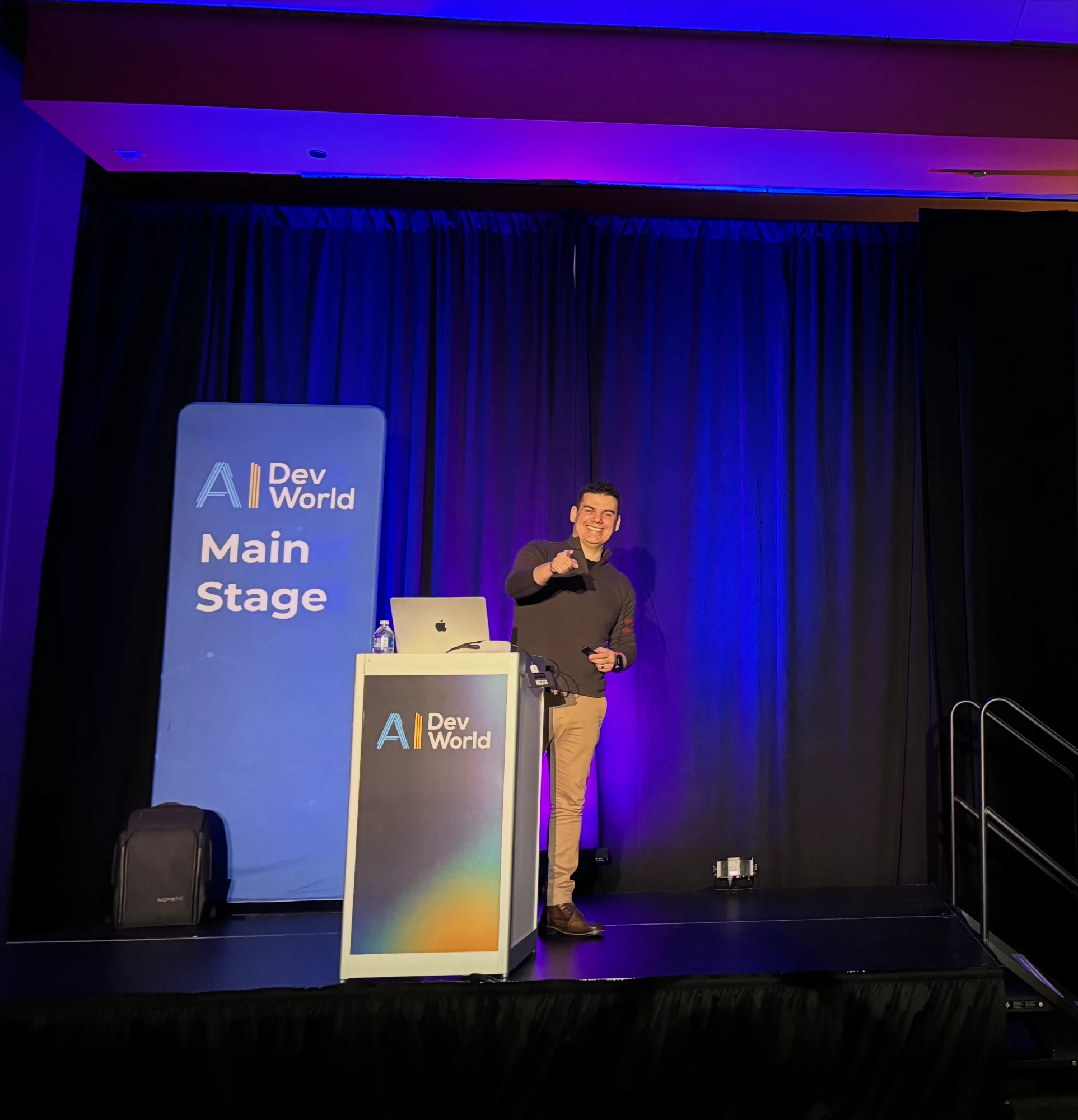
I’ve been speaking at conferences since 2008 and doing it full time as part of my work with DevRel since 2018. My talks go deep on the systems I build with: distributed systems and event streaming, AI engineering and vector search, and the data infrastructure that has to hold up when the demo ends and production begins. Some of the events I’ve spoken at include AWS re:Invent, Microsoft Ignite, Google Cloud Next, KubeCon, Oracle OpenWorld, QCon, Strange Loop, Kafka Summit, Pulsar Summit, JavaOne, DevNexus, JFokus, JNation, and All Things Open.

Ricardo Ferreira presenting on the main stage at AI DevWorld
On the main stage at AI DevWorld

You can find my upcoming and past talks on my speaking calendar. Recordings also live on my YouTube channel, and the code I write for talks, demos, and workshops is on my GitHub.

Consulting and Professional Services

If you’d like to hire me as a consultant for your projects, speak at your event, or lead a hands-on workshop for your team, contact me at riferrei@riferrei.com. I can understand the scope of your request and provide a free estimate.

Who am I?

I work at the intersection of AI, data infrastructure, and distributed systems, turning complex technology into things developers can understand and products users love.

Lately, that means hands-on AI engineering: building vector search, semantic caching, agent memory, and RAG into the data layer, and figuring out how to make AI agents secure enough to ship. I contribute to open-source projects like LangChain4j and RedisVL for Golang.

The AI-native work isn’t a pivot. It draws on the same systems-design foundation I’ve built for 20+ years: designing data systems for scale, moving data fast, watching where systems break; now applied to vectors and agents. I have worked on RDBMS and Big Data at Oracle; event streaming with Apache Kafka and Apache Flink at Confluent; observability at Elastic; AI and developer tooling at AWS; and NoSQL and vector stores at Redis. That foundation is exactly what separates AI demos that work on stage from AI systems that survive production.

Social Links