Rocky Balboa is a fictional character created and played by Sylvester Stallone, who tells the history of a boxer that faces numerous challenges throughout his life and career. But in every single movie of the series (eight produced until this date), it is impossible not to fall in love with the character. This is the first and most important thing that Kafka has in common with this character.
AWS ElastiCache is a fully managed service that allows users to easily and quickly use cache technologies like MemCached and Redis without the gory implementation details. But this doesn’t come for free. Developers often complain about the fact that the service is deployed in private subnets and due to that fact – they are not entitled to easily access for troubleshooting purposes.
A pattern to solve this problem is the usage of a bastion host, that sits between your machine and the private subnet to allow troubleshooting with ease. This post will show how to deploy a AWS ElastiCache service for Redis along with a bastion host using Terraform.
Don’t worry, you’ve came to the right place. After struggling with this myself I decided to share the solution that I’ve found with everybody else so we all can spend more time writing code than just wasting time with dependency plumbing.
Furthermore, I also had the chance to share a little about Apache Kafka in a talk that I delivered for a room full of developers interested in this technology.
Na ocasião, eu fiz parte da trilha de Big Data coordenada pela fera Fabiane Nardon, onde pude compartilhar um pouco da história do Apache Kafka , qual seu estado atual como tecnologia, e, quais casos de uso ele ajuda a resolver.
As you can read in the description, this talk is all about Confluent Cloud, where I will be showing the first steps to start working with event streaming applications using this awesome Apache Kafka as-a-service product from Confluent. However, the interesting part here is howI am going to do that.
I contribute to LangChain4j, an idiomatic open source Java library for building LLM-powered applications on the JVM. Recent work includes adding native vector search embedding stores so developers can build RAG, recommendation engines, and AI memory systems.
Public Speaking
I’ve been speaking at conferences since 2008 and doing it full time as part of my work with DevRel since 2018. My talks go deep on the systems I build with: distributed systems and event streaming, AI engineering and vector search, and the data infrastructure that has to hold up when the demo ends and production begins. Some of the events I’ve spoken at include AWS re:Invent, Microsoft Ignite, Google Cloud Next, KubeCon, Oracle OpenWorld, QCon, Strange Loop, Kafka Summit, Pulsar Summit, JavaOne, DevNexus, JFokus, JNation, and All Things Open.
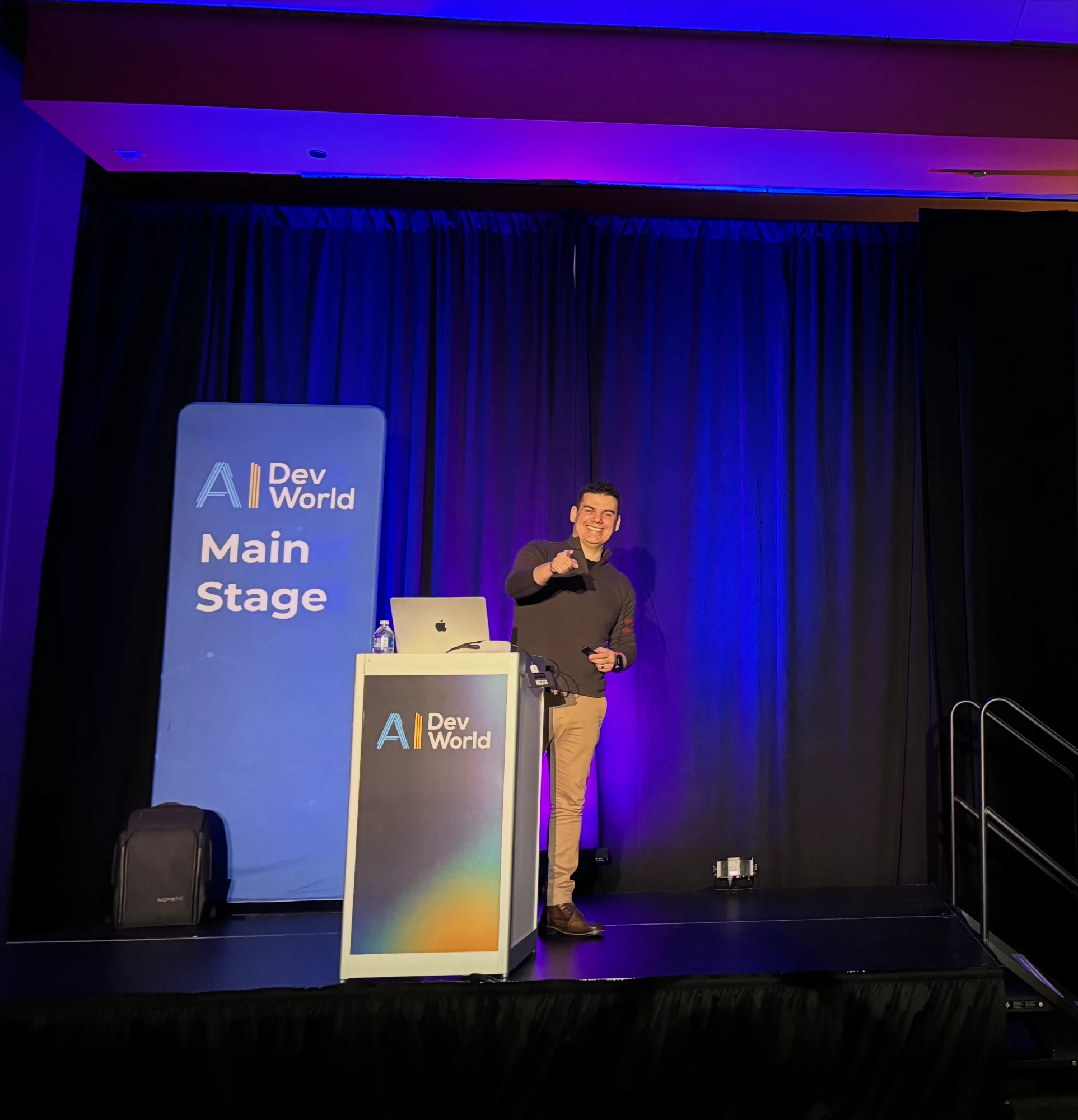
On the main stage at AI DevWorld
You can find my upcoming and past talks on my speaking calendar. Recordings also live on my YouTube channel, and the code I write for talks, demos, and workshops is on my GitHub.
Consulting and Professional Services
If you’d like to hire me as a consultant for your projects, speak at your event, or lead a hands-on workshop for your team, contact me at riferrei@riferrei.com. I can understand the scope of your request and provide a free estimate.
Who am I?
I work at the intersection of AI, data infrastructure, and distributed systems. In practice, that means hands-on AI engineering: building vector search, semantic caching, agent memory, and RAG into the data layer, and figuring out how to ship AI agents securely. I also contribute to the LangChain4j open-source project.
The AI-native work isn’t a pivot, though. It draws on the same systems-design foundation I’ve built for 20+ years: designing data systems for scale, processing fast data, watching where systems break; now applied to vectors and agents. I have worked on RDBMS and Big Data at Oracle; event streaming with Apache Kafka and Apache Flink at Confluent; observability at Elastic; AI and developer tooling at AWS; and NoSQL and vector stores at Redis.
This foundation is exactly what separates AI demos that work on stage from AI systems that survive production.