
LinkedIn and the Nightmare of Connection Requests

Monday, Jan 7, 2019 | 2 minute read

Ricardo Ferreira

Is this just me or LinkedIn became this annoying social network where recruiters and people you never worked with keep poking you for new connections?

Like other professional social networks, LinkedIn was designed to connect people around the globe and empower them with the ability to get jobs, hire talents and be the backbone for professional communication. However, that concept has been exploited because there are people that leverage this concept for their own benefits.

I don’t have a problem in making new connections, friendships, and acquaintances, but I personally can’t approve a connection request from someone that I never meet in my life, nor one that I never worked with. The former seems to be even more relevant on LinkedIn which is supposed to be for professionals. In this context, I simply cannot understand the need for people to connect with someone they never meet.

Some friends think that is unpolite denying a connection requests on LinkedIn, and they naturally disagree with my way of thinking. I don’t blame them. Perhaps I might be a little old fashion in this regard. But hey, we all can have our reservations right? For instance, I simply rate this concept of TL;DR that most people tend to use while they write, but I prefer not to criticise.

Nonetheless, it would be cool if LinkedIn would offer a way to create something – such as a challenge or a task – in which people would only be allowed to send an invitation after completing that. For Software Engineers like me that could be a simple PR filed in a project that I am working on GitHub. Rejected PRs wouldn’t count, though.
© 2018 - 2026 Ricardo Ferreira

Search is powered by Pagefind. Just hit CTRL+K or CMD+K to start searching.

Powered by Hugo with Dream and Devrel themes.

Open Source

I contribute to LangChain4j, an idiomatic open source Java library for building LLM-powered applications on the JVM. Recent work includes adding native vector search embedding stores so developers can build RAG, recommendation engines, and AI memory systems.

I also ported RedisVL to Go, an open source, AI-native client that brings vector search, semantic caching, LLM memory, semantic routing, rerankers, and an MCP server to the Redis ecosystem for Golang developers.

Speaking

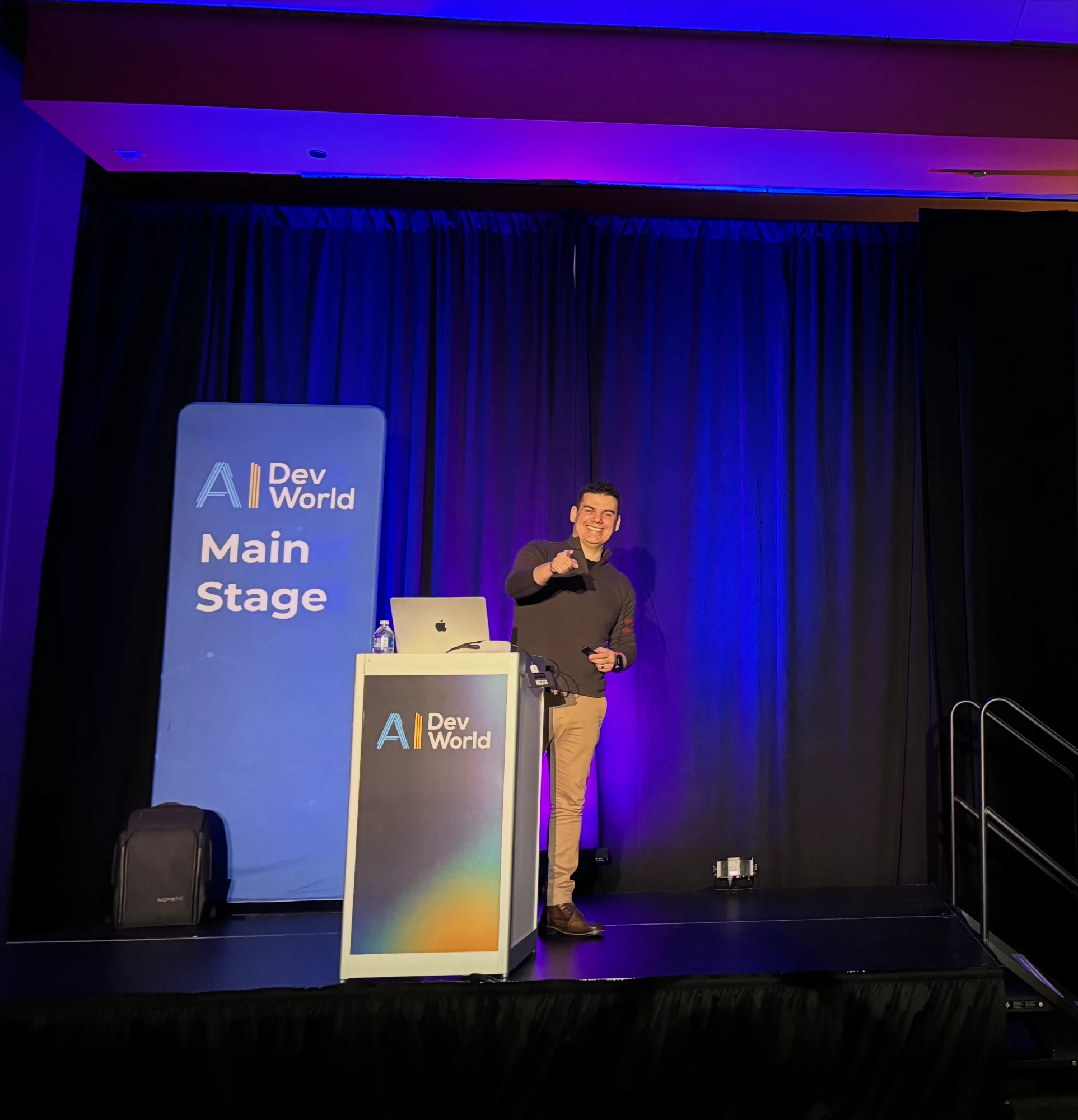
I’ve been speaking at conferences since 2008 and doing it full time as part of my work since 2018. Some of the events I’ve spoken at include AWS re:Invent, Microsoft Ignite, Google Cloud Next, KubeCon, Oracle OpenWorld, QCon, Strange Loop, Kafka Summit, Pulsar Summit, JavaOne, DevNexus, JFokus, JNation, and All Things Open.

Recordings of my talks live on my YouTube channel, and the code I write for talks, demos, and tutorials is on my GitHub.

Who am I?

I work at the intersection of distributed systems, AI, and data infrastructure, turning complex technology into things developers can understand, adopt, and build with.

Lately, that means hands-on AI engineering: building vector search, semantic caching, agent memory, and RAG into the data layer; contributing to LangChain4j and RedisVL for Golang; and figuring out how to make AI agents secure enough to ship.

The AI-native work isn’t a pivot. It draws on the same systems-design foundation I’ve built for 20+ years, moving data fast, at scale, close to compute, watching where systems break; now applied to vectors and agents. I have worked on event streaming with Apache Kafka and Flink at AWS and Confluent; observability at Elastic; as well as RDBMS, NoSQL, and Big Data at Oracle. That foundation is exactly what separates AI demos that work on stage from AI systems that survive production.

Social Links